
Buying a new washing machine seems simple until you’re standing in front of a wall of options, all listing different cubic foot measurements you have no real reference for. Capacity is one of the most important factors in choosing a washer, yet it’s also one of the most misunderstood. Too small, and you’ll be running loads constantly. Too large, and you’re wasting water, energy, and money on machines built for households twice your size.
Here’s a practical breakdown to help you pick the right fit.
Why Washer Capacity Matters
Washer capacity is measured in cubic feet, and it tells you how much laundry the drum can hold per load. A washer that’s too small forces you to split loads more often, which means more time, more water, and more electricity over the course of a month. A washer that’s too large might seem like a luxury, but oversized machines often use more water per cycle and can even wash smaller loads less effectively since clothes have more room to tumble unevenly.
The right size comes down to two things: how many people live in your home and how often you plan to do laundry.
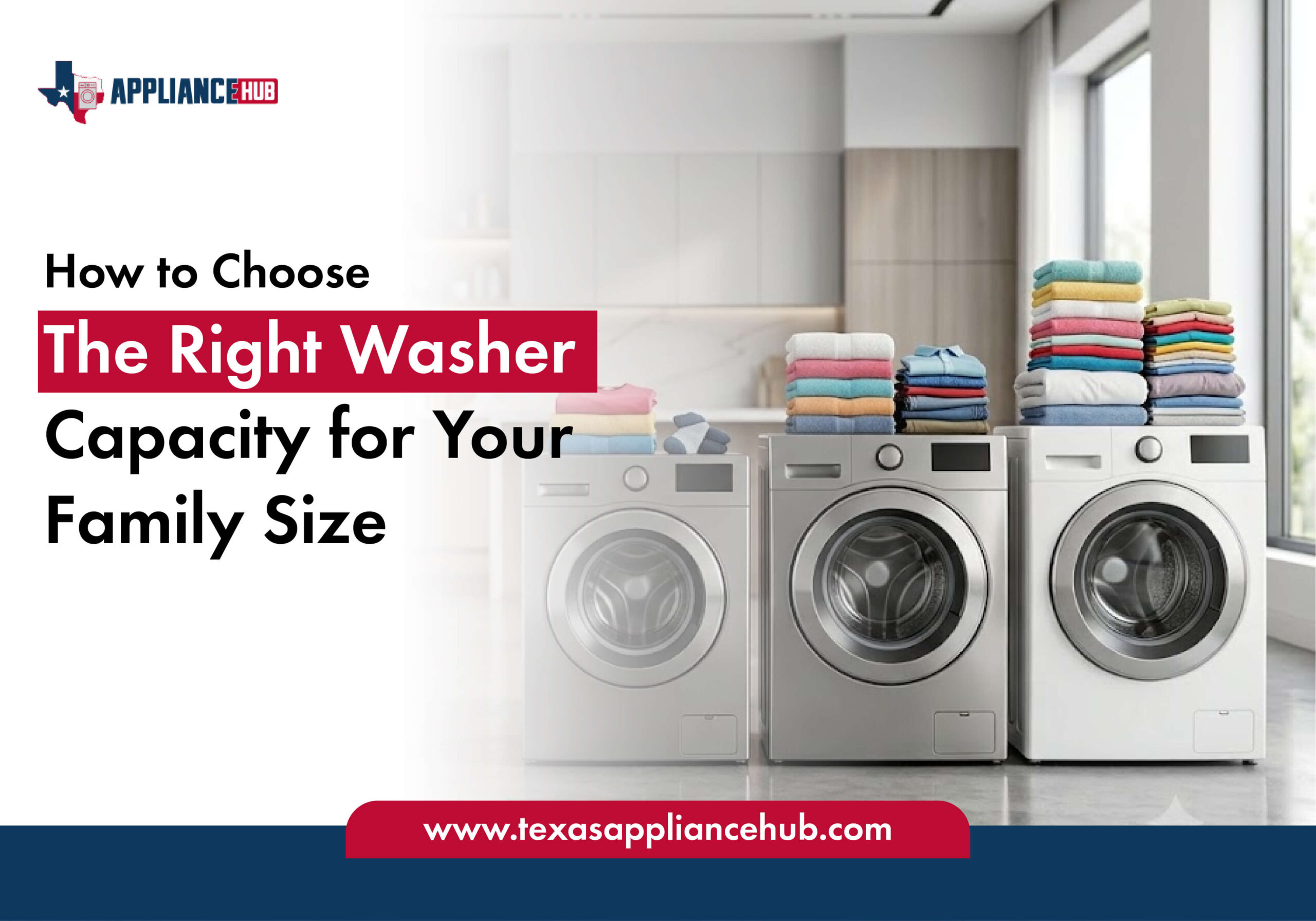
Washer Capacity by Household Size
While every household has different habits, these general guidelines can help point you in the right direction.
1 to 2 people (small households or apartments): 2.0 to 3.5 cu. ft. Compact washers in this range are ideal for singles, couples, or anyone in an apartment with limited laundry space. They handle everyday clothing loads without wasting resources on half empty drums.
3 to 4 people (small to mid-sized families): 3.5 to 4.5 cu. ft. This is the sweet spot for most households. It’s large enough to handle regular loads of clothing, plus the occasional bedding or towel load, without requiring you to do laundry every single day.
5 or more people (larger families): 4.5 to 5.5+ cu. ft. Bigger families generate more laundry, plain and simple. High capacity washers in this range cut down on the number of loads needed per week and can comfortably handle bulky items like comforters, sleeping bags, or a week’s worth of towels in one go.
Households that frequently wash bulky items If you regularly wash comforters, sports gear, pet bedding, or heavy towels, sizing up even beyond your household count can save you time and hassle, regardless of how many people live in the home.
A Simple Way to Visualize Capacity
Manufacturers often use these rough comparisons to help shoppers picture what a given capacity can actually hold:
- 3.0 cu. ft. holds roughly 12 to 15 pounds of laundry, about the size of a full hamper for one person.
- 4.0 cu. ft. holds roughly 16 to 20 pounds, enough for a typical family load including a few towels.
- 5.0 cu. ft. or more holds 20+ pounds, enough for large bedding items like king size comforters.
If you’re unsure, think about your biggest laundry challenge each week. Is it managing everyday clothes for four people, or is it the twice a month king comforter wash? That answer should guide your decision more than the household number alone.
Don’t Forget About Dryer Capacity
Your dryer should generally match or slightly exceed your washer’s capacity. If your dryer is smaller than your washer, you’ll end up splitting single washer loads into two dryer loads, which defeats the purpose of buying a larger washer in the first place. Many laundry pairs are designed specifically to match capacities for this reason, so shopping for a matched set is often the simplest solution.
Other Factors Worth Considering
Capacity isn’t the only thing to weigh when choosing a washer, but it does interact with a few other decisions:
Top load vs. front load. Front load washers often offer more usable capacity in a similar footprint compared to top load agitator models, since they don’t have a center post taking up drum space.
Frequency of laundry days. If you don’t mind doing laundry more often, you can comfortably size down and save on upfront cost and energy use per cycle.
Available space. Larger capacity machines are often physically larger too. Measure your laundry space, including doorways and hookup clearances, before assuming you can fit the biggest model available.
Energy efficiency ratings. A larger washer used efficiently can actually be more economical than a smaller washer running constant partial loads. Look for ENERGY STAR certified models to balance size with efficiency.
Final Thoughts
There’s no single “correct” washer size, only the size that fits how your household actually lives and does laundry. Start with your household count as a baseline, then adjust based on how often you wash bulky items and how much space you have available. Getting this decision right the first time means fewer loads, lower utility bills, and a laundry routine that actually works for your family instead of against it.
If you’re not sure which capacity makes sense for your home, the team at Texas Appliance Hub can help you compare washers side by side and find a set that fits both your household and your budget.