
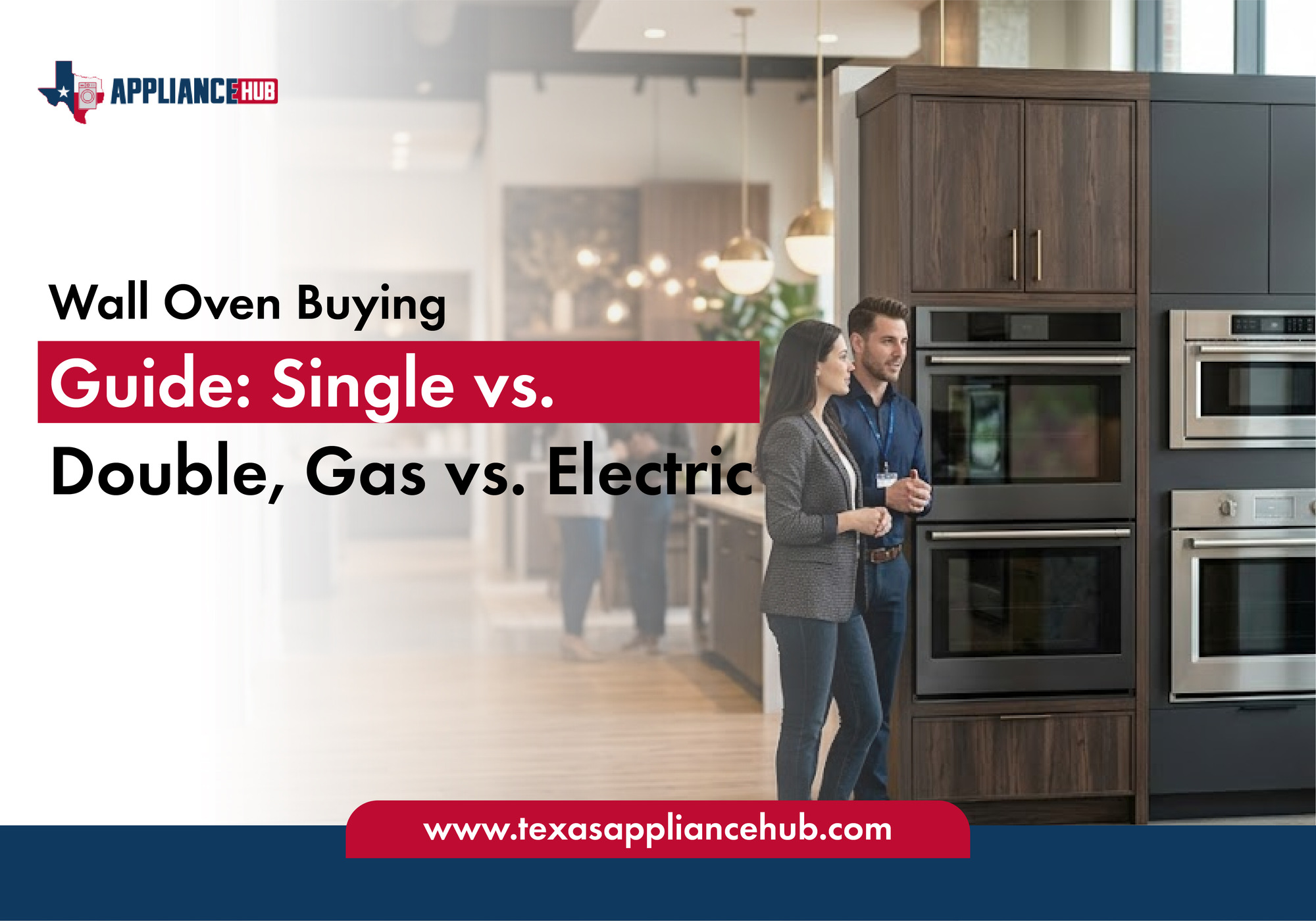
A wall oven is one of the few appliances you install once and live with for fifteen years or more. It gets built into your cabinetry, wired or plumbed into place, and it is not the kind of thing you swap out casually when you change your mind.
That makes the decision worth slowing down for. This guide covers the two choices that matter most, single versus double and gas versus electric, along with sizing, features, and installation realities that catch Houston area buyers off guard.
Why Choose a Wall Oven at All?
Before comparing models, it helps to know why people move away from a traditional freestanding range.
A wall oven separates baking from cooktop cooking. The oven goes into a cabinet at a comfortable height, and your cooktop sits independently in the counter. The advantages are real:
Ergonomics. No bending down to check a roast or lift a heavy turkey out at floor level. For anyone with back or knee issues, this alone justifies the switch.
Kitchen layout freedom. Your cooktop can go on an island while the oven sits along a wall. You are no longer forced to cluster all cooking in one spot.
A more built in look. Wall ovens sit flush with cabinetry, which reads cleaner and more custom than a freestanding range.
The tradeoffs are cost and complexity. You are buying two appliances instead of one, and installation involves cabinetry work. A wall oven plus a separate cooktop typically runs more than a comparable quality range.
Single vs. Double Wall Ovens
This is the first real decision, and the honest answer is that most households do not need a double oven.
When a single oven is the right call
A single wall oven handles everyday cooking without complaint. You can roast, bake, broil, and with many newer models, air fry. For a household of one to four people cooking normal weeknight meals, a single oven is rarely the bottleneck.
Single ovens also cost noticeably less, use less energy, and take up half the cabinet space. That freed up cabinet run can hold a microwave, a warming drawer, or just storage.
When a double oven earns its price
A double oven makes sense in specific situations:
You cook multiple dishes at different temperatures regularly. Not once a year at Thanksgiving, but often enough that the juggling frustrates you. Roasting vegetables at 425 while a casserole needs 350 is the classic case.
You host frequently. Large gatherings expose the limits of a single cavity quickly.
You bake seriously. Bakers appreciate being able to keep one oven at a stable temperature while using the other for something else.
You want a smaller cavity for small jobs. Many double ovens pair a full size lower cavity with a smaller upper one. Heating a small oven for a tray of cookies uses less energy and preheats faster.
A reasonable middle ground is a single oven paired with a countertop convection or air fryer oven, which covers most of the overflow situations at a fraction of the cost.
The combination option
Some manufacturers offer a combination wall oven, which pairs a conventional oven with a built in microwave or a speed oven in the upper cavity. This is a good fit if your kitchen is tight and you would otherwise need to find counter space or a separate microwave cutout. You do give up the flexibility of two full ovens.
Gas vs. Electric Wall Ovens
This choice is partly practical and partly about how you cook.
What your home allows
Start here, because it may make the decision for you. A gas wall oven requires a gas line to the oven location. An electric wall oven requires a dedicated 240 volt circuit, which is heavier duty than a standard outlet.
If your kitchen currently has one and not the other, converting is possible but adds cost. Running a new gas line or having an electrician install a 240 volt circuit can add several hundred dollars or more to your project, depending on the distance and the state of your panel.
Worth noting: electric wall ovens are far more common than gas wall ovens. Selection is significantly wider on the electric side, and most premium features appear there first.
How they actually differ in use
Electric ovens hold temperature more precisely and heat more evenly. The heating elements produce dry heat, which is what you want for crisp roasted vegetables, browned pastry, and good crust on bread. Most bakers prefer electric for this reason. Electric ovens also preheat somewhat faster in most modern models.
Gas ovens produce slightly moister heat because combustion releases water vapor. This can be an advantage for roasting meats, which stay juicier, and it is why some cooks swear by gas for braises and roasts. Temperature control is a bit less precise, and heat distribution tends to be less uniform without a convection fan.
Running cost depends on local utility rates. In the Houston area, natural gas is generally cheaper per unit of heat than electricity, so a gas oven typically costs less to operate. The difference over a year is modest for most households, usually not enough to drive the decision on its own.
Power outages. A gas oven still will not work during an outage in most cases, since the igniter and controls are electric. Do not count on it as a backup.
The convection question
Convection is a fan that circulates hot air through the cavity. It is available on both gas and electric models and it is genuinely worth having. Convection cooks faster, browns more evenly, and lets you use multiple racks at once without rotating pans. True convection, sometimes called European convection, adds a third heating element around the fan for even better results.
If you are choosing between a basic model and one with convection at a modest price difference, take the convection.
Sizing and Fit
Wall ovens come in three standard widths: 24, 27, and 30 inches. Thirty inch is the most common in American kitchens and offers the widest selection. Twenty four inch models suit compact kitchens, apartments, and secondary spaces.
Critical point: cutout dimensions are not the same as the oven width, and they vary between manufacturers even at the same nominal size. A 30 inch Bosch and a 30 inch Samsung may need slightly different cutouts. If you are replacing an existing oven, measure the actual cabinet opening, including height and depth, and check the specific model’s installation specifications before buying.
For double ovens, verify the total cabinet height. A double wall oven typically needs somewhere in the range of 50 inches of vertical opening, and not every kitchen has a cabinet run that accommodates it.
Also confirm the cabinet depth. Most wall ovens need roughly 24 inches, and older cabinetry is sometimes shallower than modern standards.
Features Worth Considering
Air fry. Increasingly common on electric wall ovens and genuinely useful. It uses a high speed convection setting to crisp food without a separate countertop appliance.
Self clean. Standard on most models. High heat pyrolytic cleaning is more thorough. Steam clean cycles are gentler and faster but handle only light messes.
Smart connectivity. Remote preheat and cook alerts are practical, especially if you are managing a busy household. Diagnostic alerts can also speed up service calls.
Temperature probe. A built in meat probe that shuts the oven off or alerts you at a target internal temperature. Underrated feature for anyone who roasts often.
Sabbath mode, delayed start, and multiple rack positions. Small things, but check them if they matter to you.
Installation Realities
Wall ovens are heavy, often well over 150 pounds for a double unit. This is not a solo installation. Beyond the weight:
- Electric models need a properly sized dedicated circuit, and older Houston homes sometimes need a panel upgrade.
- Gas models require a licensed connection and a leak check.
- Cabinet modification is common when the new oven’s cutout does not match the old one exactly.
- Ask whether delivery includes haul away of the old unit, since disposal of a built in appliance is not trivial.
Budget for installation as part of the purchase, not as an afterthought.
Making the Call
For most Houston area households, the practical answer looks like this: a single 30 inch electric wall oven with convection covers the vast majority of cooking, fits the widest range of kitchens, and gives you the best selection at every price point. Step up to a double oven if you genuinely cook multiple dishes at different temperatures on a regular basis. Choose gas if you already have the line, prefer moister roasting heat, and want lower operating cost.
At Texas Appliance Hub, we stock wall ovens from Bosch, KitchenAid, Electrolux, Frigidaire, GE, LG, Samsung, and Whirlpool across our Stafford, Houston, and Pasadena showrooms, including scratch and dent units that carry the same performance at a lower price. We can also help you confirm cutout dimensions before you commit, which saves a lot of grief later.
Come see the models in person or give us a call and we will walk through the measurements with you.